23:40
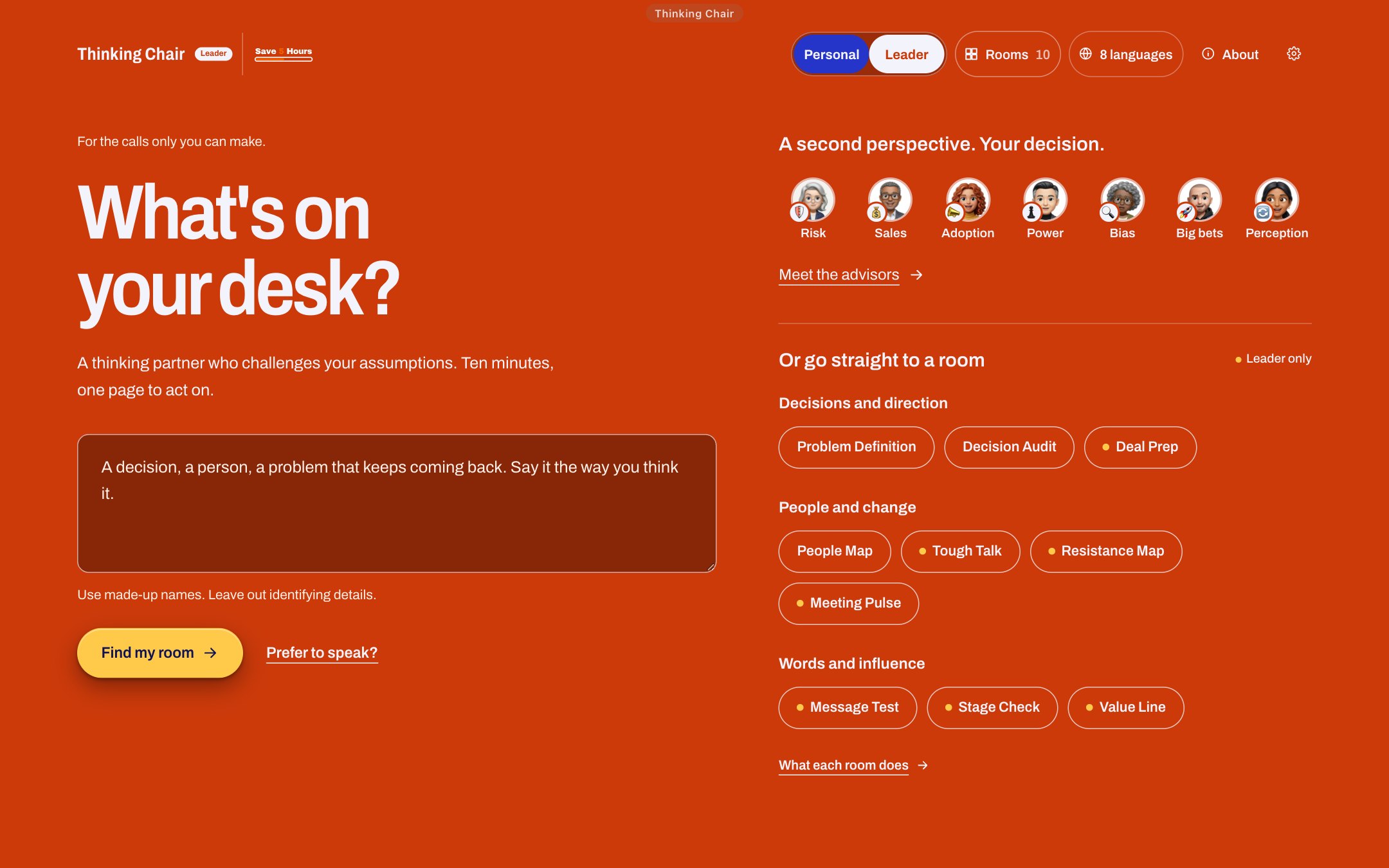
You know what to say. Not how.
Your strongest team lead, three quarters off target. At nine you tell her the role changes. The board wants it done. Your peers say: just be clear.
For people who lead people
Twelve minutes with a coach that asks the one honest question. You leave with a one-page brief.
A scripted conversation, a growing map, and the final brief. No sign-in needed.
 The Chair asks
You have been carrying something for a while.
The people around you mean well.
Most of them also have a reason to agree with you.
A top job buys you a lot of advice. It rarely buys you honest advice.
Same message. Two very different replies.
So. What are you really deciding?
Take a seatA made-up example evening.
The talk is at nine. Here is who you can ask between now and then.
Kind, and they know the company.
most of them have a reason to agree with you.
Covers the process and the wording.
it knows the rules, not her.
Honest, and good at this.
you book days ahead. The talk is tomorrow.
Fast, and always awake.
seven steps for everyone. No question for you.
The Chair: tonight, twelve minutes, one honest question, a brief for nine o'clock.
Take a seatAn example evening in Leader mode. The person and the details are made up.
A hard conversation, the wrong first sentence, nobody safe to rehearse it with. Here are the next twelve minutes.
23:40
Your strongest team lead, three quarters off target. At nine you tell her the role changes. The board wants it done. Your peers say: just be clear.
23:42
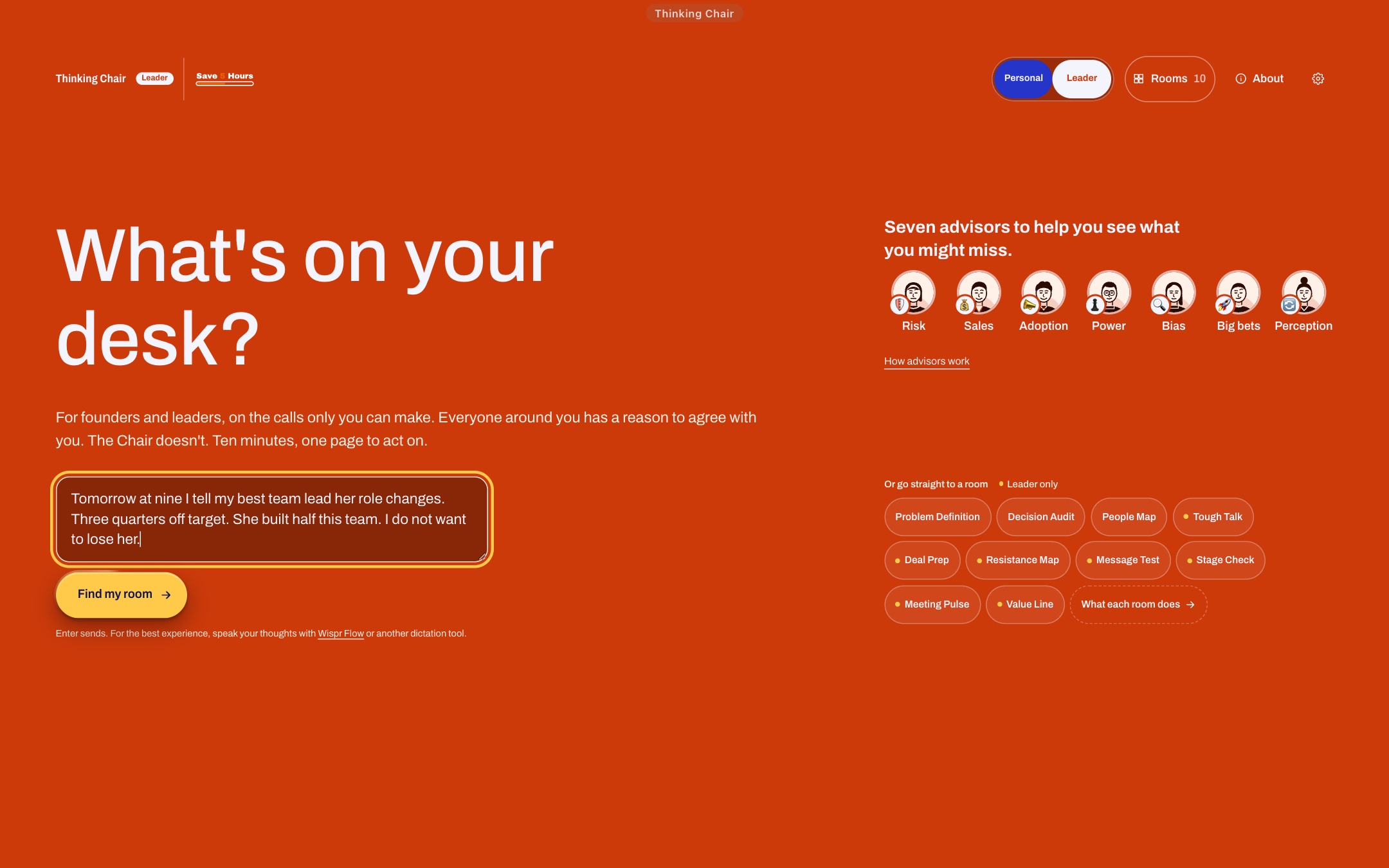
No mask, no audience. Messy is fine, and made-up names work just as well. The Chair finds the room: Tough Talk.
23:44
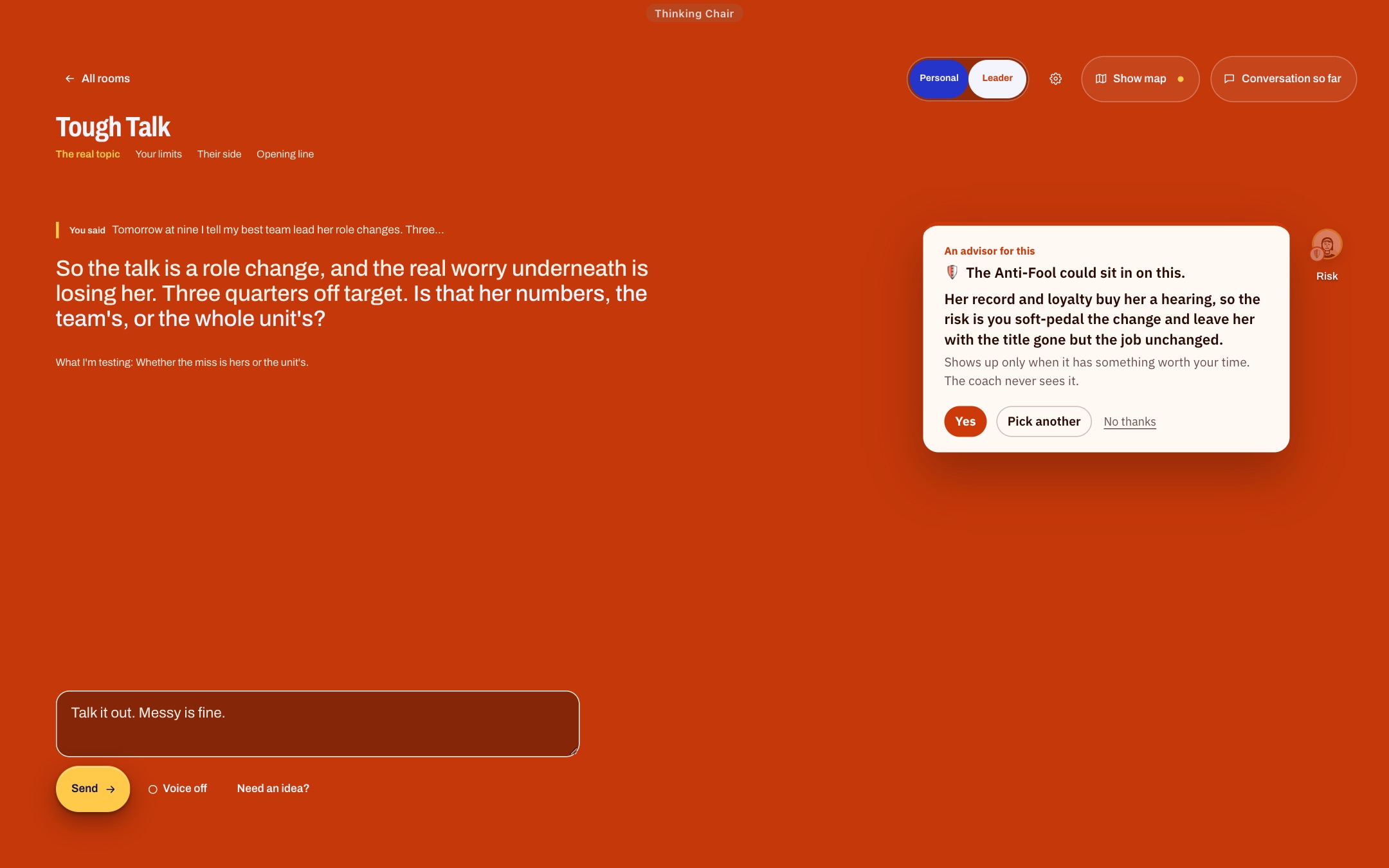
Not what to say. What you want her to do the morning after. You say: stay. It notices your plan does not get you there.
If you want her to stay, why does your first sentence end her job?A made-up example for this page
23:46
The Anti-Fool, on the side: her record buys her a hearing, so the risk is that you go soft and she keeps the title in all but name. A second view, just for you. The coach never sees it.
23:48
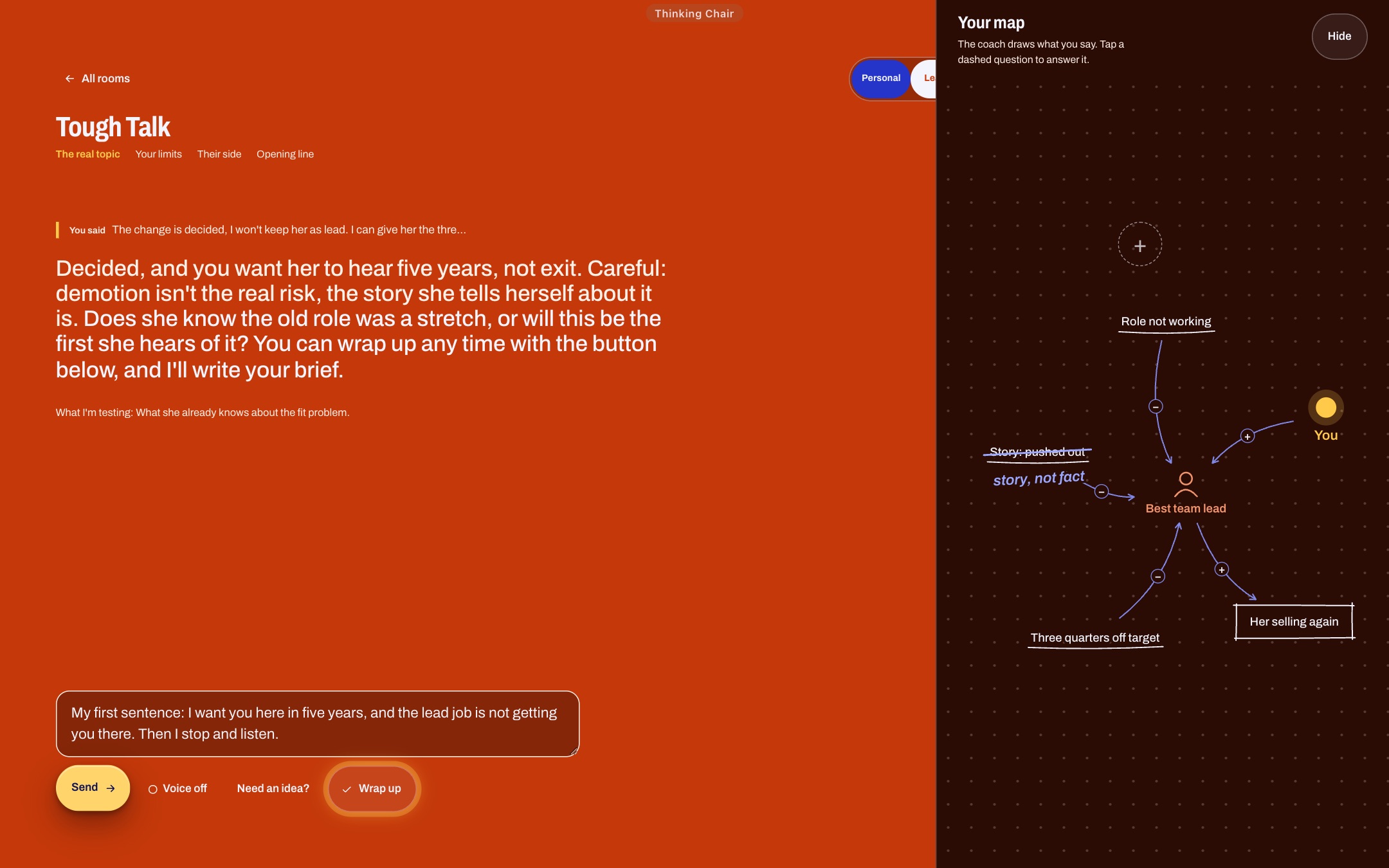
A map grows beside the conversation: you, her, the role that is not working, three quarters off target, and her selling again. Plus one thing it crossed out.
23:50
You came in asking how to deliver bad news. The map shows the real risk: not the demotion, the story she tells herself about it. Tap a box on the map to see which of your sentences put it there.
23:52
What you really want, your first sentence, what you do when it gets heated, and the advisor's closing read. Ready for nine.
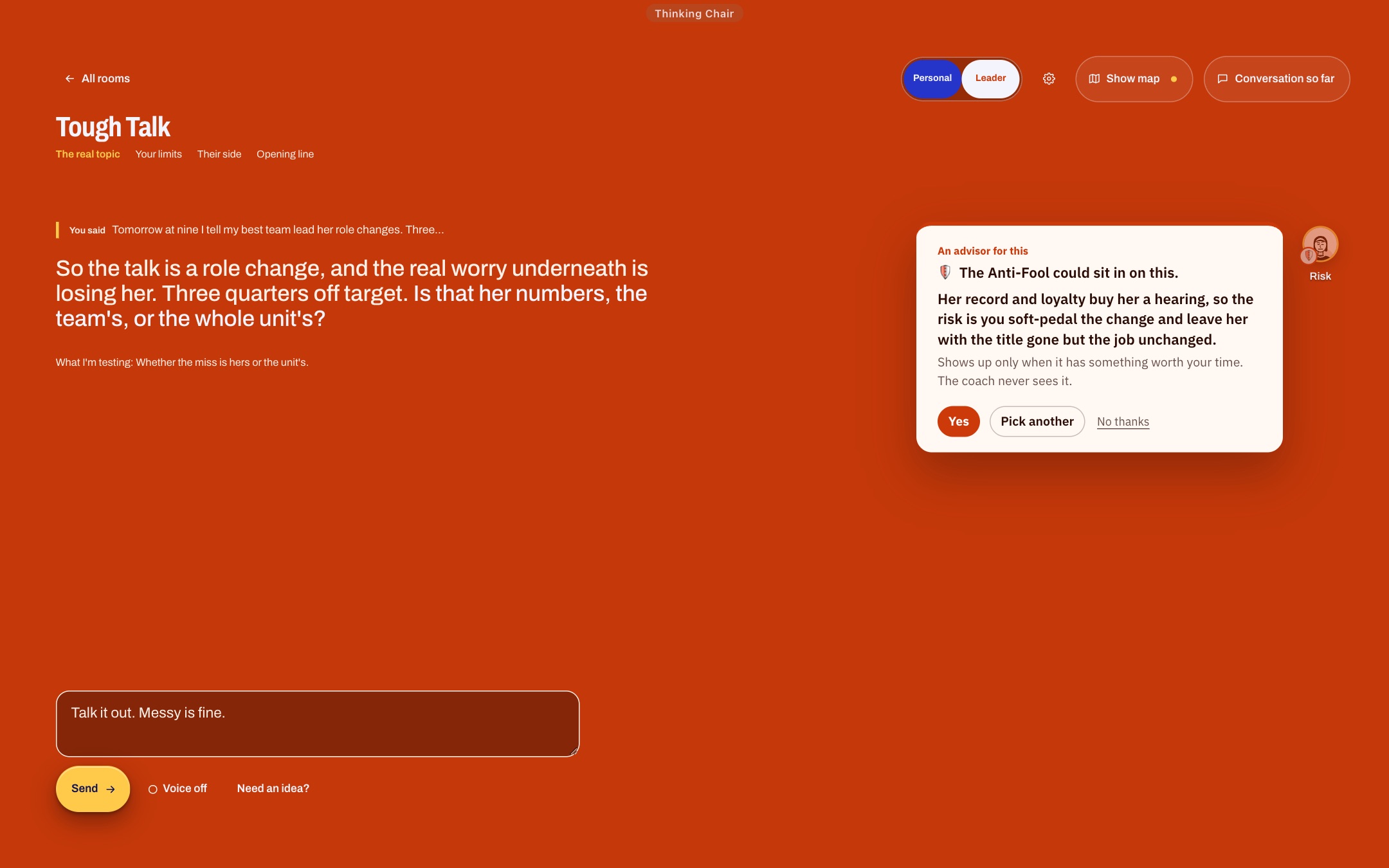
Tap a box to see where it came from.
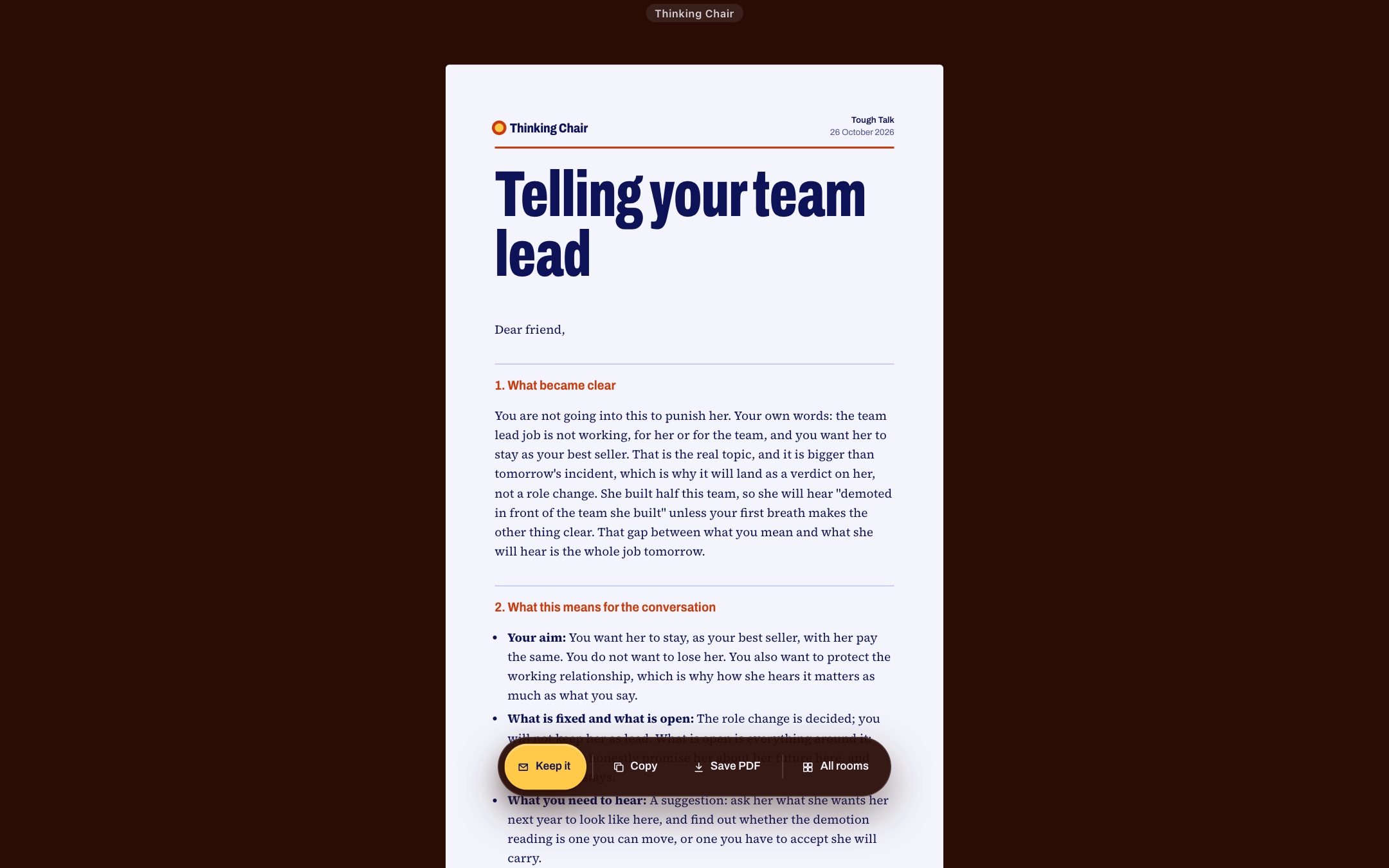
Your own nine o'clock is coming. Take a seat.
Only in Leader mode
Not a general chat. Each room follows the method a specialist uses for that exact situation: the hard talk, the negotiation, the room that will not move, the idea that could be bigger. You prepare the way you would with an expert who does this every day, and you leave with a one-page brief.
A hard conversation is coming up.
You need to negotiate something.
Someone, or a whole room, will not move on what you need.
People forget or garble a message you need them to carry.
A big talk is coming up, and it has to change the room.
A meeting you lead feels flat.
Your people describe what you do for customers in different ways.
You have an idea, and you sense it could be bigger.
Something you run needs a new idea, or one problem keeps blocking you.
Not leading anyone today? Personal mode has nine rooms for your own life: a decision, a person, a habit. Start in either, switch any time.
They don't want your job, your budget or your vote. At most one speaks, and only when it sees something worth your time. The coach never sees what it tells you.
Tap a face to meet the advisor.
Made from your own words. Follow the yellow lines to see where each line came from. Write in your language, it answers in yours.
Say it the way you think it. Four things worth knowing before you start.
Your conversation is used to answer you, then it is gone, unless you press Save. A saved conversation is visible only to you. The one-page brief is kept, so you can read it again later. It is stored with Cloudflare in Europe, linked to your Google sign-in, and only you can open it in the Chair. We do not read it. Save it as a PDF or delete it any time.
The coach only needs the shape of your situation. Leave out anything that identifies you or other people.
Your name, email and profile picture, so you can sign in. No access to your Gmail or Drive. No ads, no tracking cookies.
No card, no trial clock. Made by Roman Cajka in Zurich. Supported by Save 5 Hours.
Sign in with Google. Start in Leader or Personal, switch any time. Free during early access.
For the best experience, speak your thoughts with Wispr Flow or another dictation tool. Typing works too.